
How Do I Know If I’m Actually Ovulating?
This post contains affiliate links.
Wondering if you're really ovulating? Here are the signs to track, tools to use, and what to do if your body isn't giving clear signals.
You've been tracking your cycle. Maybe you're using an app, maybe you're counting days, maybe you've started paying more attention to how your body feels throughout the month. And yet…you're still not sure. Is ovulation actually happening? And if it is, how would you know?
This is one of the most common questions I hear from the women I work with. They're not uninformed. In fact, they're actually paying closer attention than most. But nobody ever taught them what ovulation really looks and feels like from the inside, or how to tell the difference between a cycle that looks normal on paper and one that's actually working.
Here's the short answer: you can confirm ovulation at home using a combination of three primary biomarkers - basal body temperature (BBT), cervical mucus observation, and LH (luteinizing hormone) testing - alongside optional progesterone confirmation. No single sign is definitive on its own, but together they paint a clear picture. This post will walk you through each one, explain what the research says, and help you understand what your body is actually telling you.
What Is Ovulation, and Why Does It Matter So Much for Fertility?
Ovulation is the release of a mature egg from the ovary, and it is the central event of your entire menstrual cycle. Without it, pregnancy is not possible. But here's what most women aren't told: you can have a period without ovulating. A bleed that shows up every month is not proof that your body is releasing an egg.
This matters enormously. Anovulation, or, the absence of ovulation, is one of the most common and underdiagnosed causes of fertility challenges, and it can be invisible without active tracking. According to the World Health Organization, ovulatory dysfunction accounts for approximately 25% of female infertility cases worldwide. It can be caused by PCOS (now officially renamed PMOS — polyendocrine metabolic ovarian syndrome — in a landmark May 2026 consensus paper published in The Lancet), thyroid dysfunction, chronic stress, under-eating, or hypothalamic disruption. The reassuring part: ovulation is trackable. Your body gives real, physical signals (not vague feelings, but measurable biomarkers) that tell you what's happening each cycle.
The 4 Key Signs That Confirm You’re Actually Ovulating
1. Egg-White Cervical Mucus (EWCM) — Your Body's Built-In Fertility Signal
Cervical mucus is one of the most reliable and free indicators of where you are in your cycle. As estrogen rises in the days before ovulation, the cervix produces mucus that changes in a very specific way. In the days approaching ovulation it becomes clear, slippery, and stretchy — resembling raw egg whites — which is why it's called EWCM (egg-white cervical mucus).
This type of mucus is your most fertile sign. It creates an environment where sperm can survive for up to five days and travel toward the egg. After ovulation, rising progesterone causes mucus to thicken, become cloudy or tacky, and eventually dry up until your next cycle. According to Cleveland Clinic, the presence of wet, slippery cervical mucus is the most consistent natural indicator of peak fertility in the cycle. [Cleveland Clinic guide to cervical mucus and fertility].
How to observe it: Check daily after using the bathroom, and note the consistency. Log it in a fertility app or a simple journal. After two to three cycles, patterns will emerge.
2. Basal Body Temperature (BBT) Rise — Confirmation After the Fact
Basal body temperature - your resting temperature taken first thing in the morning before getting out of bed - rises slightly after ovulation due to the increase in progesterone. This rise is typically 0.2°C (about 0.4°F) and should stay elevated for at least ten days, until just before your period arrives.
BBT confirms that ovulation happened — it does not predict it. This is an important distinction. You'll see the temperature shift one to two days after the egg was released. A sustained rise, rather than a one-day blip, is what you're looking for. According to NICE guideline CG156 (the UK's National Institute for Health and Care Excellence), BBT charting is a valid confirmation method for ovulation, though it's best used alongside other biomarkers rather than in isolation.
A biphasic chart, one with a clear lower phase before ovulation and a consistently elevated phase after, is the visual confirmation you're looking for. If your chart looks flat or erratic with no clear shift, that's worth paying attention to. Here’s more on how stress and nervous system dysregulation can flatten your BBT chart.
3. The LH Surge — Your 12–36 Hour Advance Warning
Ovulation predictor kits (OPKs) detect the surge in luteinizing hormone (LH) - the pituitary signal that triggers the egg's release - which typically peaks 24 to 36 hours before ovulation occurs. A positive OPK is a reliable advance warning that ovulation is imminent.
OPKs predict ovulation; they don't confirm it. A surge can occur without the egg actually releasing, which is more common in women with PCOS/PMOS (where multiple LH surges can appear without a true ovulation). For this reason, pairing OPK results with BBT and cervical mucus gives you a complete picture rather than relying on any single reading. [Overview of ovulation tracking methods and their evidence base].
For the most accurate results: test at the same time each day, use second morning urine (more concentrated than first morning urine but not as diluted as midday), and follow the manufacturer's instructions precisely.
4. Progesterone Confirmation — The Gold Standard
Progesterone is the hormone that rises after a successful ovulation, produced by the corpus luteum — the temporary structure that forms from the follicle after the egg is released. A progesterone blood test, typically drawn seven days after confirmed or suspected ovulation (the "7 DPO" test), is the most definitive confirmation that ovulation occurred.
A serum progesterone level of 3 ng/mL or higher indicates ovulation took place. A level below this in the mid-luteal phase suggests ovulation may not have occurred, or that luteal phase progesterone production is insufficient, a pattern that can affect implantation. You can request this test from your GP or OB-GYN, or use an at-home finger-prick kit. I dive deeper into how nourishment levels affect progesterone production in the luteal phase here if you’d like to explore that connection further.
How to Use the 3-Over-6 Rule to Confirm Ovulation in Your BBT Chart
The 3-over-6 rule is a BBT charting method used in the Symptothermal Method (a form of natural family planning) to confirm that ovulation has occurred. It works like this: ovulation is considered confirmed when you have three consecutive BBT readings that are each higher than the previous six days of temperature readings, with the third reading at least 0.2°C (0.4°F) above the highest of those six preceding days.
This rule exists because a single elevated temperature could be caused by illness, poor sleep, or alcohol - not ovulation. Three sustained elevated readings above a consistent baseline is what indicates a true hormonal shift. According to Fertility UK, if the third elevated day does not meet the 0.2°C threshold, a fourth day is observed for confirmation. [Fertility UK explanation of the 3-over-6 rule in BBT charting].
In practice: Most modern apps - including Natural Cycles, which is FDA-cleared as a contraceptive - automate this calculation for you. If you're charting manually, look for a clear biphasic pattern: a cluster of lower temps in the follicular phase, then a sustained rise in the luteal phase. That shift, held across three or more days above your previous six, is your confirmation.
What Your Cycle Is Telling You If Signs Are Absent or Unclear
If you're tracking carefully and not seeing the signs above - no EWCM, no BBT shift, erratic OPK results - that is information, not failure. It's your body asking for attention, not punishing you.
Common reasons ovulation signals may be absent or muted include chronic stress suppressing GnRH (gonadotropin-releasing hormone, the signal that kicks off the entire reproductive cascade), blood sugar instability disrupting the follicular development process, undereating or over-exercising suppressing leptin (the hormone that signals to your hypothalamus that your body has enough resources to reproduce), or an underlying condition like PMOS or thyroid dysfunction.
This is also where cycle data becomes something more than a tracking exercise. Two to three cycles of consistent charting gives you, and any practitioner you work with, a detailed picture of what your body is doing hormonally. That data is far more useful than a single snapshot appointment.
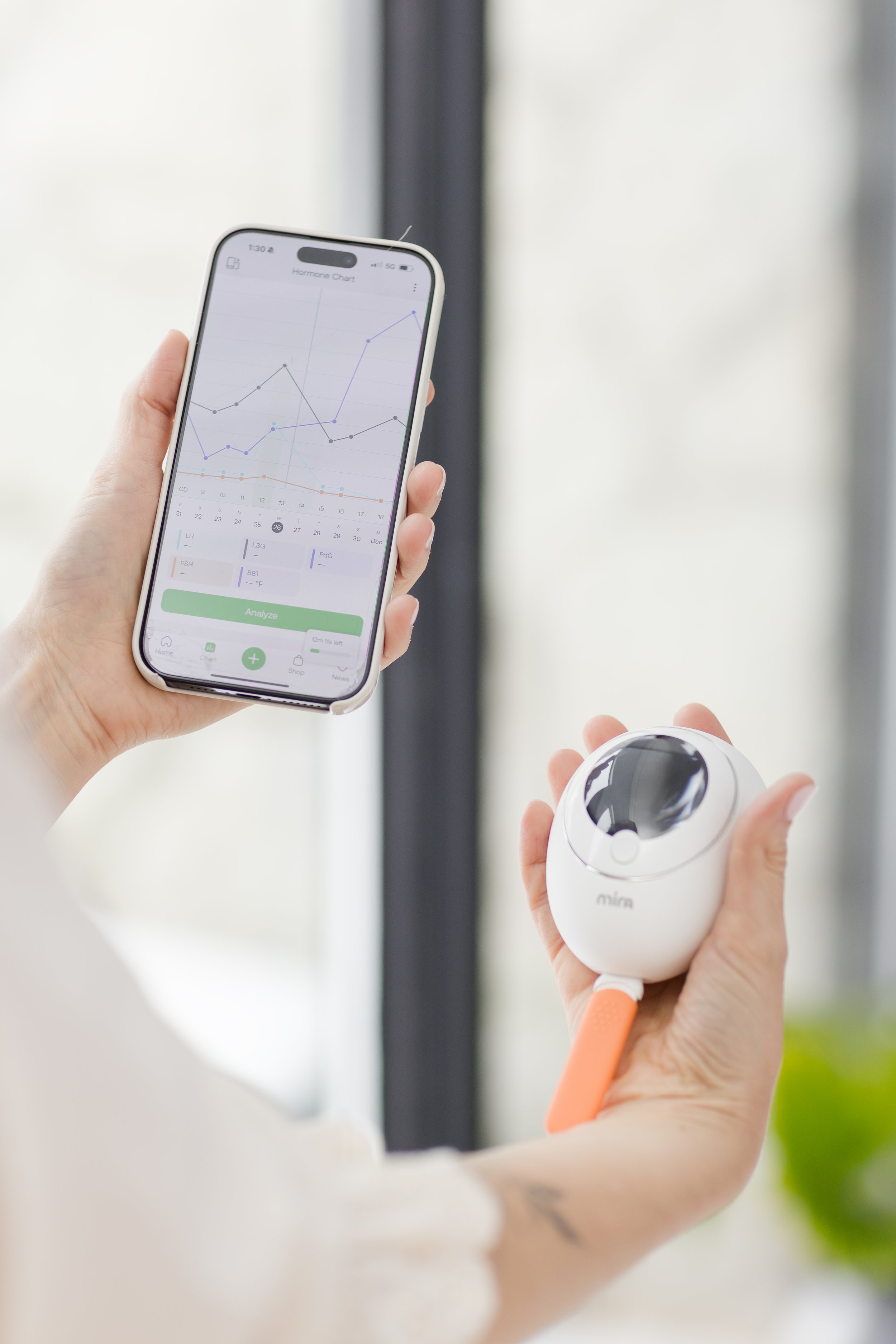
A note on Mira specifically: of all the at-home tools available, Mira is the one I recommend most consistently to the women I work with, and it's a core part of the Rewild Her Method. Unlike standard OPK strips that give you a simple positive/negative reading, Mira measures your actual hormone levels - quantitative LH, estrogen, and progesterone - so you can see the full arc of your cycle, not just a single moment in it. For women with PMOS, irregular cycles, or a history of hormonal birth control, that granularity is the difference between guessing and actually knowing. Learn more about Mira and how to use it to confirm ovulation.
FAQs: Ovulation, Fertility Signals, and What's Normal
Q: Is pregnancy 100% guaranteed when ovulating? A: No. Ovulation is necessary for pregnancy, but it doesn't guarantee it. The egg is only viable for 12 to 24 hours after release, and timing, sperm quality, uterine receptivity, and luteal phase progesterone all play roles. Conception in any given cycle — even with well-timed intercourse — has a success rate of roughly 20 to 30% in healthy couples, according to the American Society for Reproductive Medicine.
Q: Can you ovulate on Junel Fe? A: No — not when taken correctly. Junel Fe is a combination oral contraceptive containing norethindrone acetate (a progestin) and ethinyl estradiol (a synthetic estrogen). According to its FDA prescribing information, its primary mechanism is suppression of ovulation by inhibiting gonadotropins — the pituitary hormones that trigger egg development and release. The bleeding you experience during the placebo week is a withdrawal bleed, not a true menstrual period, and is not preceded by ovulation. If you are stopping Junel Fe to try to conceive, most women return to ovulation within one to three months, though individual timelines vary. Here is more on how to use cycle tracking tools to understand your hormones after stopping hormonal birth control.
Q: What is the 3-6 rule for ovulation? A: The 3-over-6 rule is a BBT charting method used to confirm ovulation has occurred. It states that ovulation is confirmed when three consecutive morning temperatures are each higher than the previous six days of readings, with the third day at least 0.2°C above the highest of those preceding six. It's used in the Symptothermal Method of natural family planning and by apps like Natural Cycles and Daysy, which automate the calculation.
Q: How can you tell if you actually ovulated? A: The most reliable at-home confirmation is a combination of three signs: egg-white cervical mucus in the days leading up to ovulation, a positive LH surge on an OPK, and a sustained BBT rise of at least 0.2°C above your previous six days held for three or more days. For clinical confirmation, a mid-luteal progesterone blood test — drawn approximately seven days after suspected ovulation — showing a level of 3 ng/mL or higher is the gold standard. No single sign is definitive; the combination is what creates certainty.
What Feeling Confident in Your Fertility Actually Looks Like
Knowing whether you're ovulating isn't about obsessing over data. It's about developing a working relationship with your body - one where you understand what it's communicating, and you have the tools to respond.The women I work with come to me feeling like their bodies are mysteries, or worse, like they've been let down by them. What I've seen, consistently, is that when a woman has two or three cycles of real data - temperature, mucus, LH patterns - she stops feeling like she's guessing and starts feeling like she actually knows something. That shift in confidence is not small. It changes how she approaches the whole fertility conversation. If you're in that place right now - tracking but not sure what you're seeing, or noticing that something feels off but not knowing where to start - a Hormone Strategy Session is exactly where we begin. We'll look at your cycle data together, map what your hormones are doing, and build a clear, personalized path forward, one that's built around your body, not a generic protocol.
👉 Book a Hormone Strategy Session to decode what your cycle is actually telling you.
👉 Book a discovery call here
Curious what’s driving your symptoms? Take the free 2-minute Untangle Your Hormones quiz to find your personalized pattern, and a clear next step to start feeling like yourself again.
Last Updated: July 2026
If you liked this post, you may also like:
→ How Leptin Supports Healthy Ovulation and Fertility
→ Why Eating More Might Be the Key to Getting Your Period Back

About the Author
Hi, I’m Sam.
I help women whose hormones have been disrupted by stress or birth control reclaim rhythm and trust in their bodies. With lived experience, deep training, and a non-restrictive, nervous-system-friendly approach, I guide you to restore hormonal balance without control or restriction.



Tired, moody, and not feeling like yourself? Learn what hormonal imbalance in women really means, what causes it, and where to start.