
Last updated: July 2026
This post contains an affiliate link (Mira). If you make a purchase through it, I may earn a small commission at no extra cost to you. I only recommend tools and products I actually use or trust.
Think HRT is only for menopause, or that it's too risky to consider in perimenopause? That myth traces back to one flawed 2002 study. Here's what the research actually shows about physiological HRT, and how to know if it's a fit for your body.
"Just Wait Until Menopause" Is Terrible Advice, and Here's Why
If you've brought up hormone replacement therapy with a doctor during perimenopause, you've probably heard some version of: "You're not in menopause yet, let's wait." Or worse, "HRT causes cancer, so let's avoid it."
I hear this constantly from women in my practice and in my personal life. They're wondering why they’re feeling so reactive, waking up drenched in sweat, gaining weight in their midsection despite no changes to their diet, and being told their labs are "normal." So they leave the appointment more confused than when they walked in.
Here's the truth: the fear around HRT traces back almost entirely to one 2002 study that has since been widely criticized by researchers, and the version of hormones that study tested isn't what's typically prescribed today. Perimenopause, the transition leading up to your final period, is often when hormone support is most protective, not something to postpone.
In this post, I'm breaking down what actually happened with that 2002 study, what physiological HRT is, and how it fits into a bigger picture of hormone balance that includes your cycle, your blood sugar, and your nervous system, not just a prescription pad.
What Is Actually Happening to Your Hormones in Perimenopause?
Perimenopause is the hormonal transition, typically lasting 4 to 10 years, where estrogen and progesterone production becomes erratic before your final period. It's not a slow, steady decline. It's a rollercoaster, and that instability is what drives most of the symptoms you're feeling.
Progesterone tends to drop first and more sharply, since it depends on regular ovulation. Estrogen, meanwhile, can swing high one month and crash the next. This is why you might feel wired and anxious one week and exhausted and foggy the next.
Common perimenopause symptoms include irregular cycles, night sweats, insomnia, mood swings, brain fog, new anxiety, joint pain, and changes in libido. Because bloodwork often looks "normal" at any single snapshot in time, many women are dismissed instead of supported.
Is It True That HRT Causes Cancer? Debunking the 2002 WHI Study
No, current research does not support the sweeping claim that HRT causes cancer. That fear started with the Women's Health Initiative (WHI), a 2002 trial that has since been widely criticized by researchers for major design flaws that skewed its results.
Here's what actually happened. The WHI enrolled 161,808 postmenopausal women aged 50 to 79, but the average participant was 63 years old, over a decade past the typical age of menopause onset. Most of these women had never taken hormones before and were starting HRT for the first time, often years after menopause, when arteries and tissues had already changed.
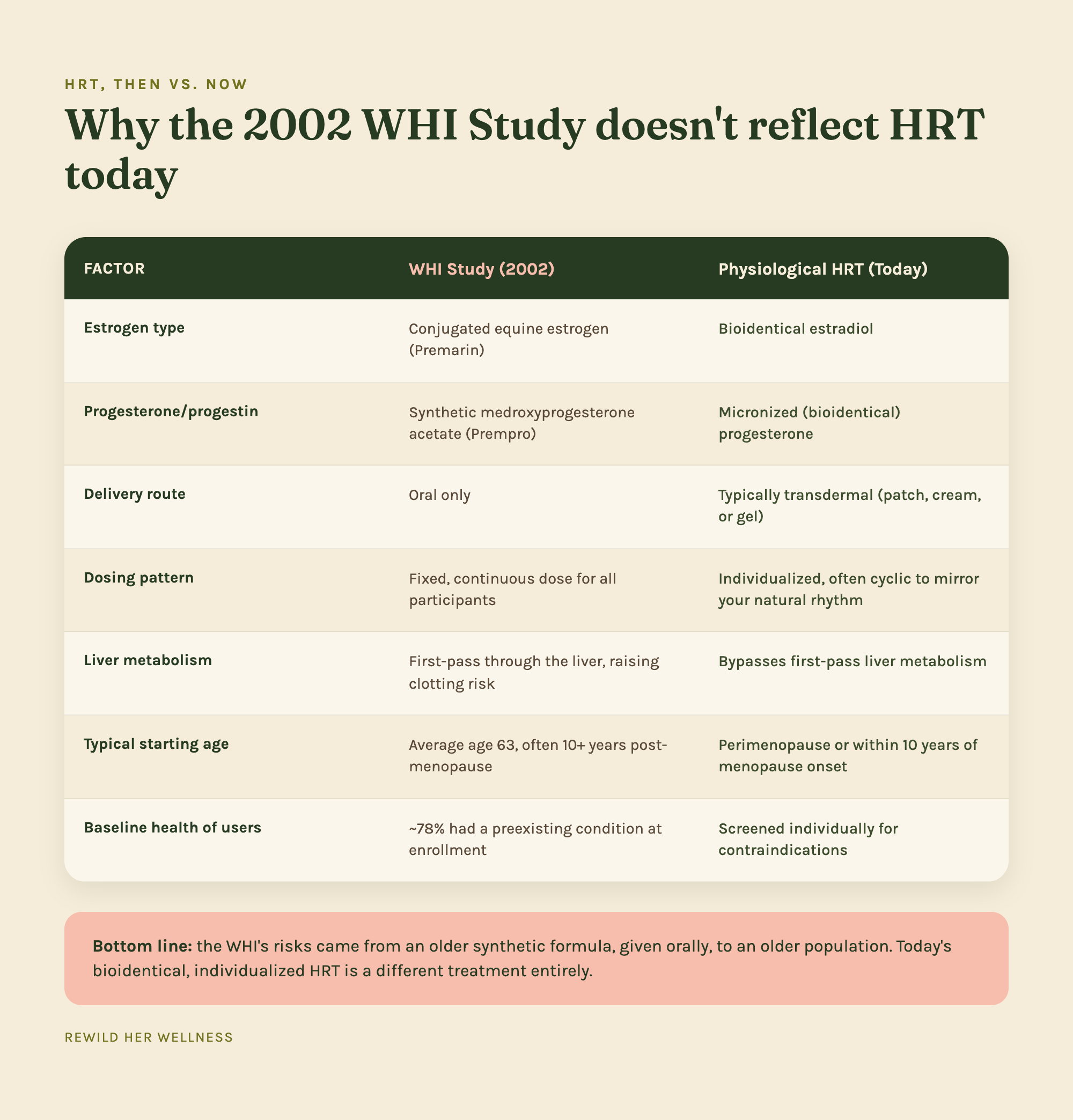
American Journal of Obstetrics & Gynecology critique of the WHI found that roughly 78% of WHI participants already had preexisting conditions like obesity, hypertension, or high cholesterol at enrollment, meaning the study was never testing HRT's effect on a healthy population to begin with. The hormones used were also outdated: oral conjugated equine estrogen made from horse urine (Premarin) and synthetic medroxyprogesterone acetate (Prempro), a progestin, not the bioidentical progesterone used in physiological HRT today.
The fallout was massive and, according to later analysis ["2013 study on HRT and premature mortality"], costly. It estimated that between 2002 and 2012, as many as 91,000 postmenopausal women in the U.S. may have died prematurely from conditions HRT could have helped prevent, after women and doctors abandoned hormone therapy nearly overnight.
By 2022, the Menopause Society's own position statement had course-corrected. The benefits of hormone therapy outweigh the risks for most healthy symptomatic women who are aged younger than 60 years and within 10 years of menopause onset, and transdermal routes of administration and lower doses may decrease the risk of blood clots and stroke compared to the oral synthetic hormones the WHI tested. That's a wildly different message than "HRT causes cancer."

What Is Physiological HRT, and How Is It Different?
Physiological HRT means dosing hormones, usually estradiol and micronized progesterone, in forms and patterns that mimic what your body naturally produces, rather than delivering a synthetic, one-size-fits-all dose. This typically means transdermal estradiol (patch, cream, or gel) instead of oral pills, paired with bioidentical, micronized progesterone rather than synthetic progestin.
The delivery method matters more than most women realize. Oral estrogen passes through the liver first, which can raise clotting risk. Transdermal estrogen bypasses that first pass through the liver, which is part of why the Menopause Society now flags it as a lower-risk route.
Physiological dosing can also mean cyclic protocols, where progesterone is layered in to mimic a natural cycle rather than given continuously, especially useful in perimenopause when your body is still producing some hormones on its own. This is a fundamentally different approach than what the WHI tested, which used a single, standardized, synthetic protocol for every participant regardless of age, symptoms, or individual physiology.
Who Is Dr. Felice Gersh, and Why Does Her Work Matter Here?
Dr. Felice Gersh is a physician dual board-certified in OB-GYN and integrative medicine and the founder of the Integrative Medical Group of Irvine, where she has spent years advocating for physiological, individualized hormone care over the standardized approach the WHI represented.
Dr. Gersh has been outspoken about the WHI's limitations, pointing out that the study was never designed to answer the question it's now famous for. She's also a strong advocate for starting hormone conversations during perimenopause rather than waiting, since estrogen receptors throughout the body, from bone to brain to blood vessels, stay more responsive the earlier support begins.
If you want to go deeper on her clinical philosophy, Dr. Felice Gersh's approach to hormone therapy is a great next read. It's the kind of individualized, whole-body thinking I bring into my own coaching work, just from the health-coaching side rather than the prescribing side.
How Do You Know If You're a Candidate for HRT in Perimenopause?
HRT isn't automatically right or wrong for every woman in perimenopause, it depends on your symptoms, your health history, and how your unique body is responding to shifting hormones. According to current guidelines, healthy women under 60 or within 10 years of their final period who have bothersome symptoms and no contraindications generally have a favorable benefit-to-risk ratio.
That said, HRT is a medical decision that has to be made with a knowledgeable prescriber who understands physiological dosing, not a generic protocol pulled off a chart. A handful of conditions, most notably a history of hormone-sensitive cancer, active blood clots or stroke, unexplained vaginal bleeding, or active liver disease, are true contraindications and mean HRT needs a specialist conversation before anything else.
Other flagged conditions, like migraines or gallbladder risk, aren't automatic disqualifiers, they just mean a lower-dose transdermal route may be safer than an oral one. Your provider needs your full picture, not just your age, to guide that decision.
Knowing what stage of perimenopause you're actually in also shapes the conversation. Clinicians use the STRAW+10 framework, where cycle-length changes of 7 or more days mark early perimenopause and 60 or more days without a period mark the late stage, so a few months of consistent cycle tracking tells your provider more than a single hormone blood draw ever could.
This is exactly why a one-size-fits-all approach, whether that's "never do HRT" or "everyone needs HRT," misses the point. Your hormone picture is shaped by your cycle history, your stress load, your blood sugar regulation, and your nervous system, not just your age.

Why Hormone Balance Requires More Than a Prescription
HRT can be an incredibly valuable tool in perimenopause, but it isn't the whole picture. Your daily rhythms shape how your body uses and responds to hormones in the first place. This is the piece that gets left out of most "generic hormone programs," and it's the foundation of the work I do with clients.
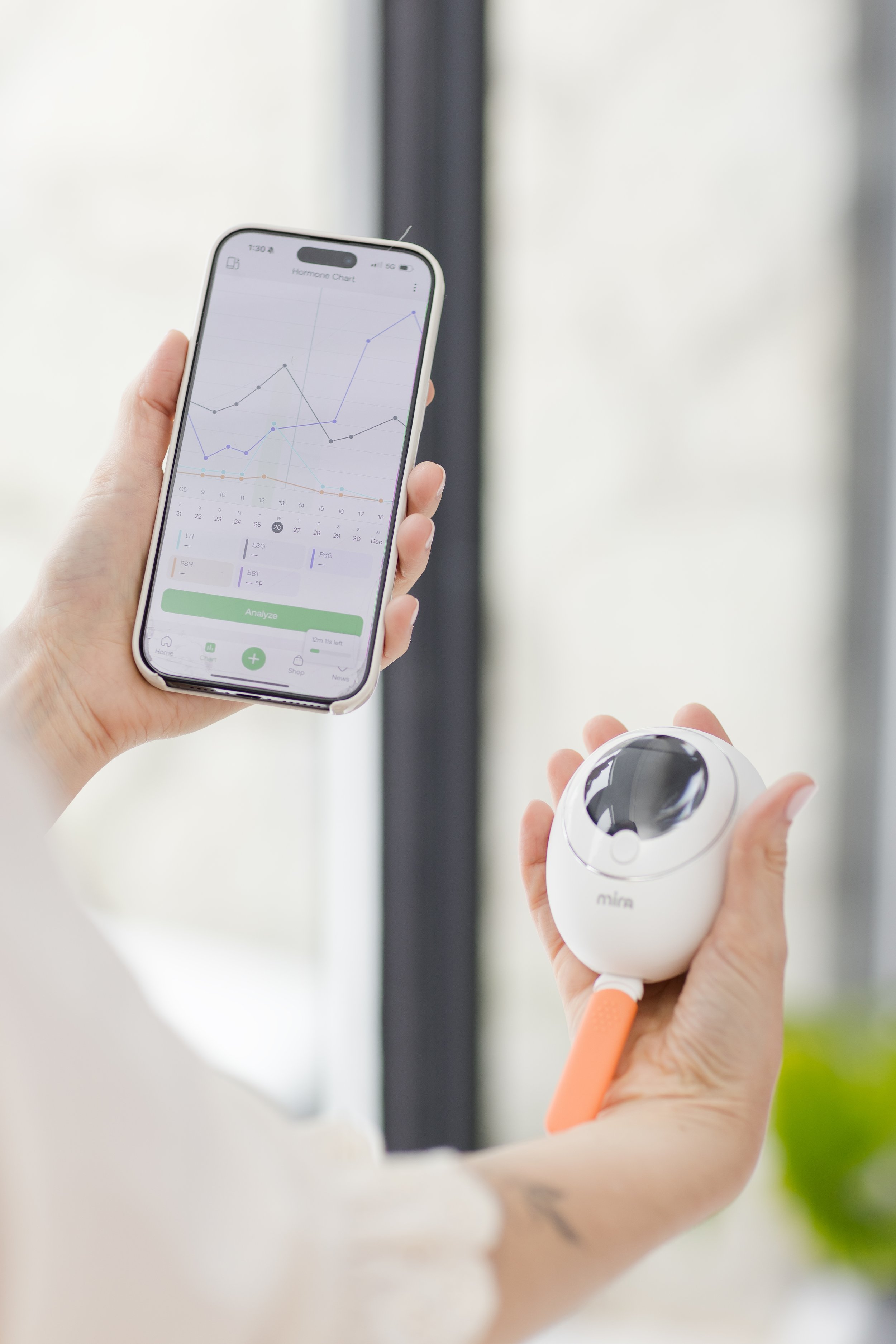
Tracking your cycle, even an irregular one, gives you and your provider real data instead of guesswork about what's happening month to month. Mira is one of the tools I recommend for this and use with all of my clients, since it measures actual hormone metabolites rather than relying on averages or app-based predictions. If you want the bigger picture on why this kind of tracking matters, how femtech and hormone tracking can help you understand your cycle breaks it down further.
Blood sugar regulation is the next piece, and it's one most women are never told about. Estrogen and progesterone both influence insulin sensitivity, so as they fluctuate in perimenopause, blood sugar swings can worsen mood crashes, cravings, and night sweats, whether or not you're on HRT. I go deeper on this connection in my blog post, your period problems might actually be blood sugar problems.
Finally, your stress response and cortisol patterns directly compete with your sex hormones for the same raw materials and receptor pathways. This is why two women on the exact same HRT protocol can have very different results: one is regulating her nervous system daily, and one is running on adrenaline and four hours of sleep. Nervous system regulation for better hormones walks through practical ways to start closing that gap.
A body-neutral, whole-person approach means HRT (if it's right for you) works with your lifestyle instead of trying to override it. That combination, personalized medical support plus daily hormone-supportive habits, is what actually restores trust in your body during this transition.
FAQs: HRT in Perimenopause
Q: Can you take HRT while still getting periods in perimenopause? A: Yes. Physiological HRT protocols, especially cyclic ones using transdermal estradiol and progesterone, are specifically designed for women still cycling in perimenopause, not just women who've reached menopause.
Q: Is bioidentical HRT the same as what the WHI study tested? A: No. The WHI tested oral conjugated equine estrogen and synthetic medroxyprogesterone acetate, while physiological or bioidentical HRT typically uses transdermal estradiol and micronized progesterone, which current research links to a different, generally lower-risk profile.
Q: What's the difference between perimenopause and menopause for HRT purposes? A: Perimenopause is the transition with fluctuating hormones before your final period; menopause is officially marked one year after your last period. Many experts, including Dr. Felice Gersh, argue hormone support is most protective when started during perimenopause rather than delayed.
Q: Does HRT cause breast cancer? A: The blanket claim comes from the 2002 WHI study, which has since been widely criticized by researchers for its older, unhealthy cohort and outdated synthetic hormones. Current Menopause Society guidance finds a favorable benefit-risk ratio for most healthy, symptomatic women under 60 or within 10 years of menopause onset.
Q: How do I know if my symptoms are perimenopause or something else? A: Tracking your cycle and symptoms over 2 to 3 months gives you and your provider real patterns to work from instead of a single snapshot in time. [INTERNAL LINK: /hormone-health-blog/signs-of-hormonal-imbalance-in-women — "11 signs your body is talking to you"] is a good place to start identifying what you're noticing.
Q: How do I know if I need HRT during perimenopause? A: You may be a candidate if you have bothersome symptoms, like disruptive night sweats, sleep loss, or mood changes, that are affecting your quality of life, and you don't have contraindications like a history of certain cancers or blood clots. This is ultimately a conversation to have with a provider who reviews your full health history alongside your symptoms.
Q: What disqualifies you from HRT? A: Common contraindications include a personal history of breast or other hormone-sensitive cancers, active blood clots or a history of stroke, unexplained vaginal bleeding, and active liver disease. Some of these are absolute contraindications, while others, like migraines or gallbladder risk, may just mean a different route (like transdermal) is safer, so it's worth a specific conversation rather than assuming you're automatically excluded.
Q: What is the average age for HRT in perimenopause? A: Perimenopause typically starts in the mid-40s, sometimes as early as the late 30s, and lasts 4 to 8 years, with the median age of the final period around 51 to 52. Current guidelines find HRT's benefit-risk ratio most favorable for healthy women under 60 or within 10 years of menopause onset, which covers most of the perimenopause window.
Q: How do I know what stage of perimenopause I'm in? A: Clinicians typically use the STRAW+10 staging system, where early perimenopause is marked by cycle-length changes of 7 or more days and late perimenopause by 60 or more days without a period. Tracking your cycle length consistently for a few months is the most reliable way to see which stage you're actually in, since a single hormone blood draw is often misleading during this window.
Your Body Was Never the Problem
The fear around HRT was built on a flawed study, outdated hormone formulations, and a healthcare system that too often hands women a chart instead of a conversation. Physiological HRT, paired with real support for your cycle, blood sugar, and stress, is a very different starting point than what most women were warned about.
You don't have to figure out whether HRT, lifestyle shifts, or both are right for you on your own. A hormone strategy session is where we map your personalized hormonal blueprint together, so you can walk into any HRT conversation with your provider informed and confident, not confused and dismissed.
👉Book a Hormone Strategy Session
This post is educational and not a substitute for personalized medical advice. Always talk with a knowledgeable prescriber about your individual health history before starting or stopping any hormone therapy.
Last Updated: July 2026

Curious what’s driving your symptoms? Take the free 2-minute Untangle Your Hormones quiz to find your personalized pattern, and a clear next step to start feeling like yourself again.
If you liked this post, you may also like:
→ 11 Signs of Hormonal Imbalance in Women
→ Why Eating More Might Be the Key to Getting Your Period Back

About the Author
Hi, I’m Sam.
I help women whose hormones have been disrupted by stress or birth control reclaim rhythm and trust in their bodies. With lived experience, deep training, and a non-restrictive, nervous-system-friendly approach, I guide you to restore hormonal balance without control or restriction.



Perimenopause weight gain isn't a willpower problem. Here's why fasting can backfire and what really helps you feel strong, steady, and at home in your body.