

Last updated: August 2026
This post contains affiliate links and I may earn a small commission at no extra cost to you. I only recommend tools and products I personally use and trust.
Tired, moody, and not feeling like yourself? Here is what hormonal imbalance in women really means, what causes it, and where to start.
Here's a fun game: Google "hormonal imbalance symptoms" and see how many apply to you!
Tired but wired? Check. Mood swings? Check. Skin that's staging a rebellion? Check. Periods that show up whenever they feel like it? Oh, absolutely check. ✅
Hormonal imbalance in women is one of the most common and most misunderstood health concerns out there and it’s far more common than most people realize. The WHO estimates that PCOS alone affects 6-13% of women of reproductive age globally, and up to 70% of those affected remain undiagnosed. That's before accounting for thyroid disease, endometriosis, estrogen dominance, and the many women whose symptoms are real but whose labs come back "normal."
Here's what we don’t learn: your hormones don't exist in isolation. They operate in a specific hierarchy, meaning some hormones boss others around, and imbalances rarely show up one at a time. More importantly, your hormones aren't the problem. They're the messenger. An imbalance is your body's way of flagging something deeper going on.
In this guide, we're going to break down the hormone hierarchy from top to bottom, walk through every major type of hormonal imbalance, what causes it, what it feels like, and where to start.
No overwhelm, no shame. Just real information, finally!

What Is Hormonal Imbalance and Why Is It So Common in Women?
Hormonal imbalance occurs when one or more hormones are produced in amounts that are too high or too low relative to what your body needs to function well. It sounds simple, but the ripple effects can touch nearly every system in your body: your mood, metabolism, cycle, skin, sleep, and fertility.
Women are disproportionately affected for a few reasons. Female physiology involves a complex monthly hormonal cycle that requires precise coordination between the brain, adrenal glands, and ovaries. Add in modern stressors, synthetic chemicals in our environment, and a healthcare system that has historically treated the male body as the default (gross), and you have a perfect storm.
The important thing to know upfront: multiple hormone imbalances almost always exist at the same time. Fixing one without addressing the others is like turning off one smoke alarm while the kitchen is still on fire.
What Are the First Signs of Hormonal Imbalance?
The earliest signs of hormonal imbalance in women are often dismissed as just "stress" or "getting older." They include persistent fatigue that sleep does not fix, mood changes in the second half of your cycle, irregular periods, skin breakouts that don't respond to topical treatments, difficulty concentrating, and changes in libido or sleep quality.
The catch is that these symptoms can point to several different hormonal patterns. That is why understanding how your hormones relate to each other matters more than chasing a single symptom.
The Hormone Hierarchy: Why Some Hormones Run the Show
Not all hormones are created equal. Your body operates on a hormone hierarchy, a priority system that determines which hormones get produced first when resources are limited.
Think of it like a company org chart. The CEO doesn't take direction from the interns. Similarly, your top-tier hormones will always be produced at the expense of lower-tier ones when your body is under stress.
Here's how the hierarchy breaks down:
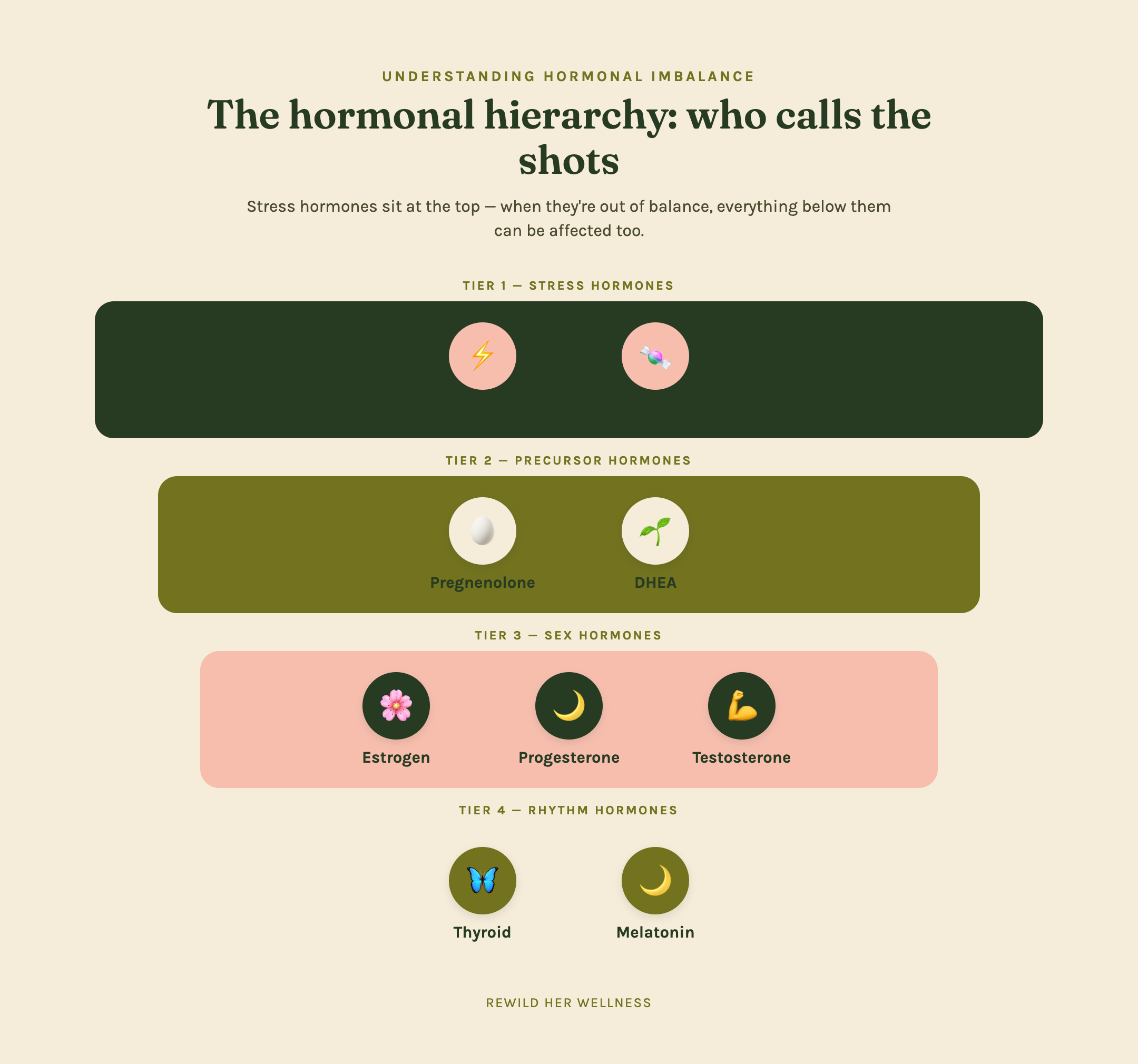
Your body will always prioritize Tier 1. When cortisol is chronically elevated, because of ongoing stress, under-eating, overexercising, or illness, your body steals resources from Tier 2, 3, and 4. This is why stress wrecks your period, crashes your libido, and leaves you exhausted despite sleeping eight hours. Ovulation irregularities, low progesterone, and thyroid dysfunction are very often the end result of cortisol and insulin dysregulation, not separate issues that appeared out of nowhere. If you’re interested in exploring this connection further, I cover this comprehensively in this post.
Cortisol Imbalance: The Root of Most Hormonal Disruption
High Cortisol: What It Feels Like and What’s Causing It
High cortisol, also called HPA axis dysregulation, is the most common starting point for hormonal imbalance in women. The HPA axis (hypothalamic-pituitary-adrenal axis, the brain-to-adrenal communication system) pumps out cortisol in response to stress. The catch is that our modern lives have given it a lot to respond to.
Causes of chronically elevated cortisol include:
Extreme dieting, restrictive eating, and eating disorders
Overexercising or high-intensity training without adequate recovery
Food sensitivities and allergies triggering ongoing immune activation
Childhood trauma (which can permanently alter HPA axis set points)
Chronic infections, autoimmune diseases, and cancer
Exposure to electromagnetic fields (EMFs), an emerging area of research
Symptoms of High Cortisol:
That "wired but tired" feeling: you're exhausted but can't wind down
Anxiety and a low-level sense of being on edge
Getting a second wind at 10 or 11pm (classic sign)
Difficulty falling or staying asleep
Waking up feeling like you haven't slept at all
Energy crashes in the afternoon
Increased belly fat, especially around the midsection
Cravings for sugar or salt
Difficulty concentrating or brain fog
A weakened immune system: catching every cold going around
Irregular ovulation or anovulatory cycles (cycles where no egg is released) [How chronic stress disrupts ovulation]
Low Cortisol: What Happens When Your System Has Been Running on Fumes
Low cortisol doesn't come out of nowhere. It almost always follows a long period of high cortisol. Think of your HPA axis like a battery. Years of chronic stress, inadequate nourishment, and pushing through exhaustion can drain it to the point where it simply can't produce adequate cortisol anymore.
You may have heard this called "adrenal fatigue" in functional medicine circles. It's worth knowing that the adrenals themselves cannot get fatigued in the way that phrase implies, and more than the adrenals are involved in this process. The more precise clinical term is HPA axis dysfunction, which captures the broader brain-to-adrenal communication breakdown more accurately. True cortisol deficiency, called Addison's disease, is a distinct medical diagnosis. Congenital adrenal hyperplasia (CAH), a genetic condition affecting adrenal hormone production, is another separate cause.
Symptoms of Low Cortisol Include:
Profound fatigue that sleep doesn't fix
Difficulty staying asleep or waking in the middle of the night
Feeling unrested no matter how long you sleep
Low blood pressure and dizziness when standing
Body aches and muscle weakness
Dramatically decreased stress tolerance: small things feel enormous
Depression, persistent negativity, and a sense of being unable to cope
An important note: the state of your HPA axis also determines how well you digest and absorb food and supplements. This is why you can be doing "everything right" nutritionally and still not feeling results. Your body may not be absorbing what you're giving it.
Progesterone Shifts: Why the Ratio Matters More Than the Number
Low Progesterone and What It Signals
Low progesterone is one of the most common hormonal patterns in women, and it's almost always connected to what's happening with cortisol upstream. The ratio of progesterone to estrogen is what matters most. When that ratio is off, it's often because progesterone has dropped, not because estrogen has spiked.
Here's the mechanism: when the HPA axis is activated and cortisol is elevated, the hormones that govern ovulation get suppressed. Ovulation is the primary source of progesterone production. Disrupted or absent ovulation means inadequate progesterone. It's that direct.
Cortisol also physically blocks progesterone receptors, making them less responsive even when progesterone is present. Your body may have the hormone but can't use it properly.
This is why ovulation, not just menstruation, is the true marker of a healthy hormonal cycle. You can get a period without ovulating, but you can't get adequate progesterone without it.
Signs your progesterone may be lower than optimal:
Difficulty getting or staying pregnant
Breakthrough bleeding mid-cycle
Emotional PMS symptoms: crying, irritability, or mood swings in the days before your period
Menstrual migraines
Heavy menstrual flows
Shorter cycles or more frequent periods (under 25 days)
Anxiety that spikes in the second half of your cycle (the luteal phase)
Swollen or painful breasts before your period
There are some really cool ways to tell if you’re ovulating that don’t involve trying to figure out your cervical position.
Estrogen: Something Worth Paying Attention To On Both Ends

When Estrogen Runs High Relative to Progesterone
Estrogen dominance refers to elevated estrogen relative to progesterone in the luteal phase, the second half of your cycle. Estrogen is supposed to be the dominant player in the first half of your cycle, before ovulation. After ovulation, progesterone rises and balances it out. When that doesn't happen, estrogen dominance is the result.
Causes include:
Poor estrogen clearance: your gut and liver are responsible for breaking down and eliminating used estrogen. When they're not functioning optimally, estrogen recirculates.
Xenoestrogens: synthetic estrogen-like compounds found in plastics (BPA), pesticides, personal care products, and non-organic dairy and meat ["xenoestrogens and endocrine disruption, NIH"]
Excess adipose tissue: body fat produces estrogen, so higher levels of body fat increase circulating estrogen. A note here: "excess" is a loaded and genuinely difficult thing to measure, and body weight alone is not a reliable indicator of hormonal health. Research consistently shows that health outcomes are far more strongly associated with lifestyle factors like movement, sleep, stress, and nutrition, than with body size itself. You can be in a larger body and have healthy estrogen clearance, and you can be in a smaller body and have poor clearance. What we're really talking about here is metabolic function, not a number on a scale.
Symptoms largely overlap with low progesterone (because the pattern is about the ratio), but estrogen dominance can also exacerbate estrogen-sensitive conditions like uterine fibroids and endometriosis.
When Estrogen Runs Low
Low estrogen is typically caused by sporadic or absent ovulation, since ovulation is what drives estrogen production in the first half of the cycle. Chronic stress, under-eating, and HPA axis dysregulation can suppress the HPO axis (hypothalamic-pituitary-ovarian axis, the brain-to-ovary communication pathway), which in turn lowers estrogen.
What are the 10 signs of low estrogen? The most common signals include:
Irregular or absent periods (amenorrhea)
Low libido
Vaginal dryness and painful sex
Hot flashes or night sweats (yes, even in your 30s)
Joint pain or stiffness
Dry skin and eyes
Mood changes, depression, or emotional flatness
Poor memory and difficulty concentrating
Disrupted sleep
Decreased bone density over time
I know this low estrogen from top to bottom. When I was on a low-dose synthetic birth control pill, I experienced nearly every symptom on that list, despite the fact that the pill is often prescribed to "regulate" hormones. When I came off, my period was completely absent for 10 months while my estrogen worked to restabilize. What helped wasn't a protocol or a supplement stack, but rest, eating enough (genuinely enough and more than felt comfortable at first), and prioritizing hormone-supportive foods and healthy fats. That experience is a big part of why I do this work, and why I take a whole-body, nourishment-first approach with every person I work with.
Androgen Imbalance: Testosterone Is Not Just a Male Hormone
When Androgens Run High
Androgens, including testosterone, DHT (dihydrotestosterone), DHEA, and androstenedione, are present in all women and serve essential functions. When they're produced in excess, the body lets you know. The most common driver of excess androgens in women is high insulin.
When blood sugar is chronically elevated and insulin is high, it signals the ovaries to produce more androgens and suppresses SHBG (sex hormone-binding globulin, a protein that keeps testosterone inactive in the bloodstream). The result is higher free testosterone circulating in the body.
Other causes include HPA axis dysregulation, congenital adrenal hyperplasia (CAH), and certain hormonal birth control formulations containing synthetic progestins with androgenic activity.
Signs androgens may be running high:
Unstable blood sugar and insulin resistance
Infrequent ovulation
Acne, especially along the jaw and chin
Ovarian cysts
Mid-cycle or ovulation pain
Cycles longer than 35 days
Facial hair growth
Hair thinning or loss on the scalp (androgenic alopecia)
More on the blood sugar and hormone connection…
When Androgens Run Low
Low androgens are less talked about but significantly affect quality of life for many women. Causes include ovarian removal, primary ovarian insufficiency (POI), and dysfunction in the adrenal glands or ovaries. Hormonal birth control, specifically the pill, is also a major driver: it suppresses ovarian testosterone production and elevates SHBG, which binds to remaining testosterone and makes it inactive.
When women stop the pill, it can take anywhere from several months to years for SHBG to normalize and testosterone to recover. This is one of the reasons post-pill libido changes can persist long after stopping.
Signs androgens may be lower than optimal:
Little to no interest in sex
Difficulty with lubrication and painful intercourse
Weaker or less frequent orgasms
Low motivation and reduced self-confidence
Fatigue and flat mood
Decreased muscle mass and bone density
Thyroids Hormones: The Great Pretender
Why Thyroid Imbalance Is So Often Missed in Women
Women are five to eight times more likely than men to develop thyroid disease, according to the American Thyroid Association, and yet thyroid conditions are frequently missed or dismissed because symptoms overlap with so many other conditions.
Thyroid hormones (primarily T4, the inactive form, and T3, the active form your cells use) regulate your metabolism, temperature, energy production, and mood. When output is low, a condition called hypothyroidism, every system in your body slows down.
Causes of low thyroid hormone output include:
Hashimoto's thyroiditis: an autoimmune condition where the immune system attacks the thyroid gland, and the most common cause of hypothyroidism in the US [Hashimoto's thyroiditis, American Thyroid Association]
HPA axis dysfunction: chronically elevated cortisol suppresses the conversion of inactive T4 into active T3
Synthetic chemicals: including flame retardants, fluoride, and certain pesticides that interfere with thyroid function
Nutrient deficiencies: specifically iodine, selenium, and vitamin D, all necessary for thyroid hormone production
Symptoms of low thyroid hormone:
Chronically dry skin, hair, and brittle nails
Hair loss
Cold hands and feet; sensitivity to cold temperatures
Exhaustion that is disproportionate to your activity level
Unexplained weight gain
Depression and mood changes
Low sex drive
Heavy periods
Difficulty conceiving
One crucial note: standard TSH (thyroid-stimulating hormone) testing often misses subclinical thyroid dysfunction. If you suspect thyroid issues, ask your provider for a full thyroid panel including TSH, Free T3, Free T4, Reverse T3, and thyroid antibodies.
How Can You Check Your Hormonal Imbalances?
There are a few different ways to get a clearer picture, and they work best together.
Cycle tracking is a powerful, free starting point. Tracking your basal body temperature (BBT), cervical mucus, cycle length, and symptoms over 2 to 3 months gives you and a practitioner a real-time window into what's happening hormonally. If you want to take your tracking deeper, the Mira hormone monitor measures your actual LH, estrogen, and progesterone metabolites at home with clinical-grade accuracy. Use code 2SAMOREY20 for 20% off.
Functional lab testing goes deeper than standard panels and can assess hormones in context. The DUTCH test (Dried Urine Test for Comprehensive Hormones) provides a detailed view of sex hormones, cortisol patterns across the day, and hormone metabolites. Standard bloodwork is a starting point, but it often misses the full picture.
Your symptoms are data. Sleep quality, cycle patterns, mood shifts, skin changes, and energy levels tell a story. A practitioner who knows how to read that story alongside labs can help you connect the dots rather than chasing isolated numbers.
How Do You Fix Imbalanced Hormones? How Do You Reset Them?
There is no single reset button, and anyone selling you one deserves a skeptical eyebrow raise. What there is: addressing the root causes that are driving the imbalance in the first place, which almost always means starting at Tier 1 of the hormone hierarchy.
That looks different for every person, but common starting points include:
Stabilizing blood sugar through consistent meals with adequate protein, fat, and fiber
Reducing HPA axis load by identifying and addressing the stressors, whether physical, emotional, or environmental, that are keeping cortisol elevated
Supporting gut and liver health for proper estrogen clearance
Eating enough (under-eating is one of the most underappreciated drivers of hormonal disruption in high-achieving women)
Giving it time: most practitioners suggest 3 to 6 months minimum for meaningful hormonal shifts, aligning with the roughly 90-day follicle development cycle
The state of your HPA axis also determines how well you absorb the food and supplements you're already taking. This is why protocol-stacking without addressing the root rarely works.
FAQs: Hormonal Imbalance in Women
Q: What are the first signs of hormonal imbalance in women? A: Early signs include persistent fatigue that sleep doesn't resolve, mood changes in the second half of your cycle, irregular or missing periods, acne along the jawline, low libido, and difficulty concentrating. These symptoms often appear before lab values shift outside the "normal" range, which is why symptoms matter as data.
Q: What are the 11 signs that your hormones are out of whack? A: The most common signs are: fatigue, mood swings or anxiety, irregular periods, heavy or painful periods, low libido, sleep disruption, weight changes (especially belly fat), skin and hair changes, hot flashes or night sweats, digestive shifts, and difficulty conceiving. Most women experience several of these at once because hormonal imbalances rarely travel alone.
Q: How can I check my hormonal imbalances? A: Start with cycle tracking (BBT, cervical mucus, symptoms) and a symptom journal over 2 to 3 months. From there, functional lab testing such as the DUTCH test gives a comprehensive hormonal picture. At-home hormone monitors like Mira can also track LH, estrogen, and progesterone metabolites in real time. Always work with a practitioner who can interpret results in context.
Q: How do you fix or reset imbalanced hormones? A: There is no universal reset, but the most effective starting point is addressing Tier 1 of the hormone hierarchy: blood sugar stability and HPA axis regulation. From there, supporting gut and liver health, eating adequately, reducing physiological stressors, and giving the body 3 to 6 months to recalibrate covers most of the foundational work.
Q: Are hormonal imbalances permanent? A: In most cases, no. Hormonal patterns reflect what's happening in your body right now, not a fixed state. Addressing root causes such as chronic stress, under-eating, poor gut health, or environmental exposures can meaningfully shift hormonal patterns over time. Change is possible, and it often happens more gradually than we'd like.
Q: Can you have multiple hormonal imbalances at the same time? A: Yes, and it's the norm rather than the exception. Because hormones operate in a hierarchy and influence each other, a shift in one area (like cortisol) creates downstream effects in others (like progesterone, estrogen, and thyroid hormones). This is why looking at the full picture matters more than targeting one hormone at a time.
So, Where Do You Go From Here?
Hormonal imbalance in women is common. But common doesn't mean inevitable, and it definitely doesn't mean you have to white-knuckle your way through your symptoms indefinitely.
Your hormones aren't betraying you. They're doing their best with the inputs they're getting. The goal is to understand what they're responding to, and start there.
If you're not sure where to begin, the free, 2-minute quiz below can help you identify your primary hormone pattern and what your body might need next.
And if you're ready to stop guessing and start working through this with real support, a discovery call is the first step.
Last Updated: August 2026
If you liked this post, you may also like:
→ Are My Hormones Off? 11 Signs Your Body Is Talking to You
→ How Do You Know If You’re a Candidate for HRT in Perimenopause?
→ Why Can’t I Lose Weight With PCOS?
→ Is It Normal to Have Perimenopause Symptoms in my 30’s?
→ Why Do I Get So Bloated Before My Period?
→ Acne After Stopping Birth Control? What to Do
→ How to Get Your Period Back After Birth Control
→ The Gift of Doing Less: What’s Possible When You Stop Trying So Hard

About the Author
Hi, I’m Sam.
I help women whose hormones have been disrupted by stress or birth control reclaim rhythm and trust in their bodies. With lived experience, deep training, and a non-restrictive, nervous-system-friendly approach, I guide you to restore hormonal balance without control or restriction.


Perimenopause weight gain isn't a willpower problem. Here's why fasting can backfire and what really helps you feel strong, steady, and at home in your body.