

Last updated: August 2026
This post contains an affiliate link and I may earn a small commission at no extra cost to you. I only recommend tools and products I actually use and trust.
Struggling to lose weight with PCOS (now renamed PMOS)? Learn what's going on, what treatment helps, and a gentler plan forward.
This question comes up frequently from clients and friends. If you've been eating "clean," moving your body, and still feeling stuck in the same place no matter what you try, I want to say this first: it's not you. Weight loss with PMOS works differently in the body, and no amount of willpower changes the biology underneath it.
Here's the promise of this post: PCOS makes weight loss harder because of insulin resistance and hormonal fat storage patterns, not because you're doing something wrong. Understanding that mechanism is what opens up a workable plan. As of May 2026, PCOS also has a new name, PMOS, which I'll explain below because it changes how we understand the condition too (and no, you didn't miss a memo, most of the internet hasn't caught up either). 🙂
By the end, you'll know why the "eat less, move more" advice keeps failing you, what's really behind that stubborn “PCOS belly”, where medication fits in honestly, and how to approach this without declaring war on your body.
What Is PCOS (Now Officially Renamed PMOS)?
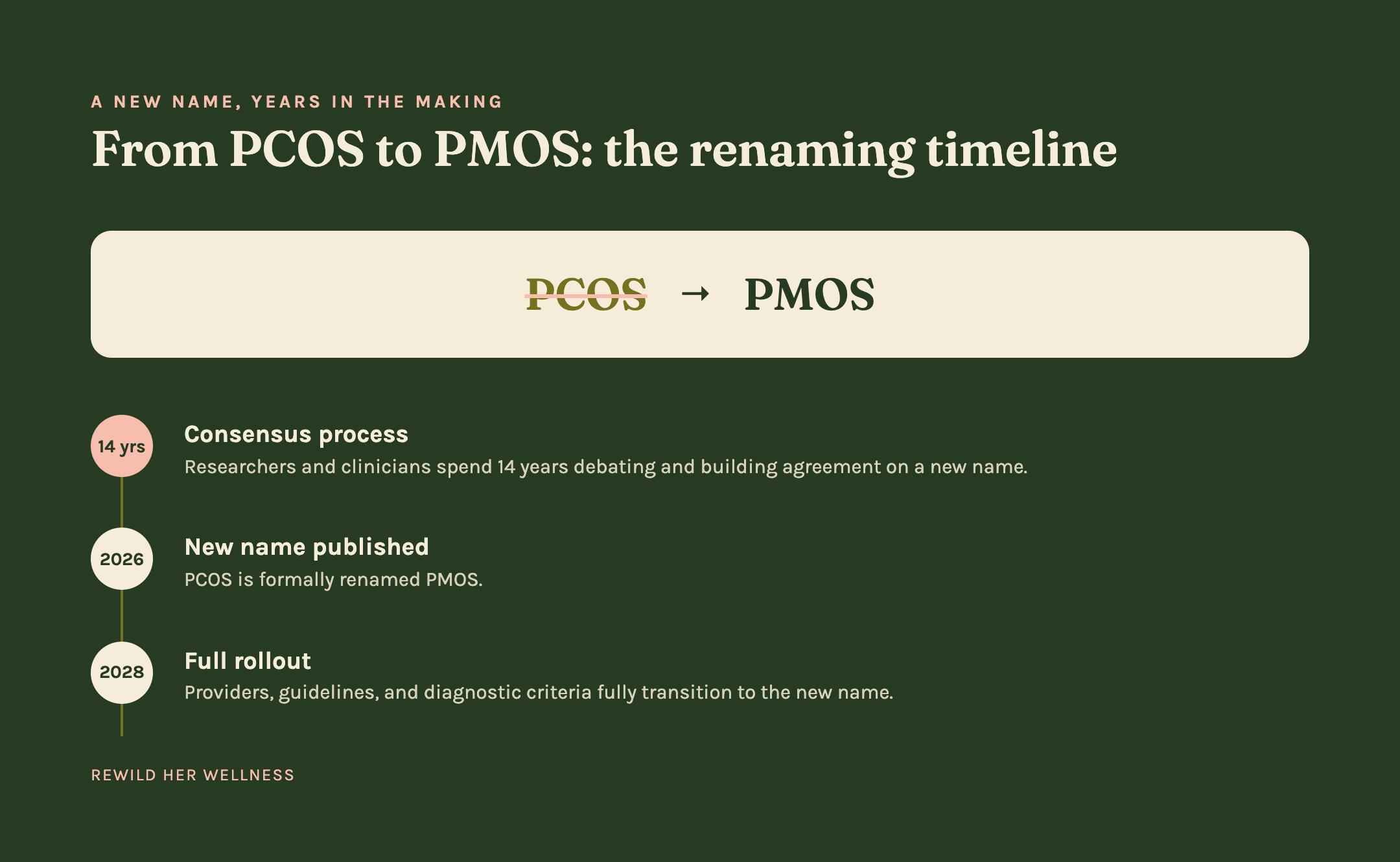
In May 2026, a global consensus of researchers renamed polycystic ovary syndrome (PCOS) to polyendocrine metabolic ovarian syndrome, or PMOS. The change was published in The Lancet on May 12, 2026, led by Monash University after a 14-year process involving over 14,000 patients and clinicians worldwide.
The reasoning: "polycystic ovary syndrome" centers ovarian cysts, which aren't even a defining feature for a lot of people with the condition. PMOS better reflects what's really going on, a whole-body endocrine and metabolic condition, not just an ovarian one.
This matters for how we understand the condition, because the new name puts the metabolic piece (the part driving most of what you're feeling day to day) front and center instead of burying it under a reproductive label. You'll still see "PCOS" everywhere for a while, on your chart, your labs, your prescriptions, since full clinical rollout isn't expected until 2028. I'll use both terms in this post so you can find what you need either way.
PCOS Isn’t a Flaw In Your Body
Before we get into mechanisms, I want to offer a reframe that changed how I hold this condition with clients. In her book PCOS SOS, Dr. Felice Gersh describes PCOS as, in her words, "a natural female variant," a hormonal pattern women have carried for thousands of years, not a malfunction. I first encountered this idea during my training at the Institute for Menstrual Health, and it's stuck with me ever since.
Gersh's argument is that many PCOS traits were likely protective for our ancestors. Mild inflammation kept the immune system primed and ready. Mild insulin resistance and elevated androgens helped earlier generations of women store energy through famine and build physical strength. Reduced fertility spaced pregnancies further apart, which may have improved survival odds for both mother and baby.
What's changed isn't your body, it's the environment. Gersh's view is that PCOS becomes disease-like mainly because modern life, with its chronic stress, disrupted sleep, and processed food, is such a poor match for this particular hormonal pattern. Your body isn't broken. She's asking for a different environment than the one most of us live in now, and that's exactly what a personalized plan can offer.
Why Doesn't "Eat Less, Move More" Work for PCOS?
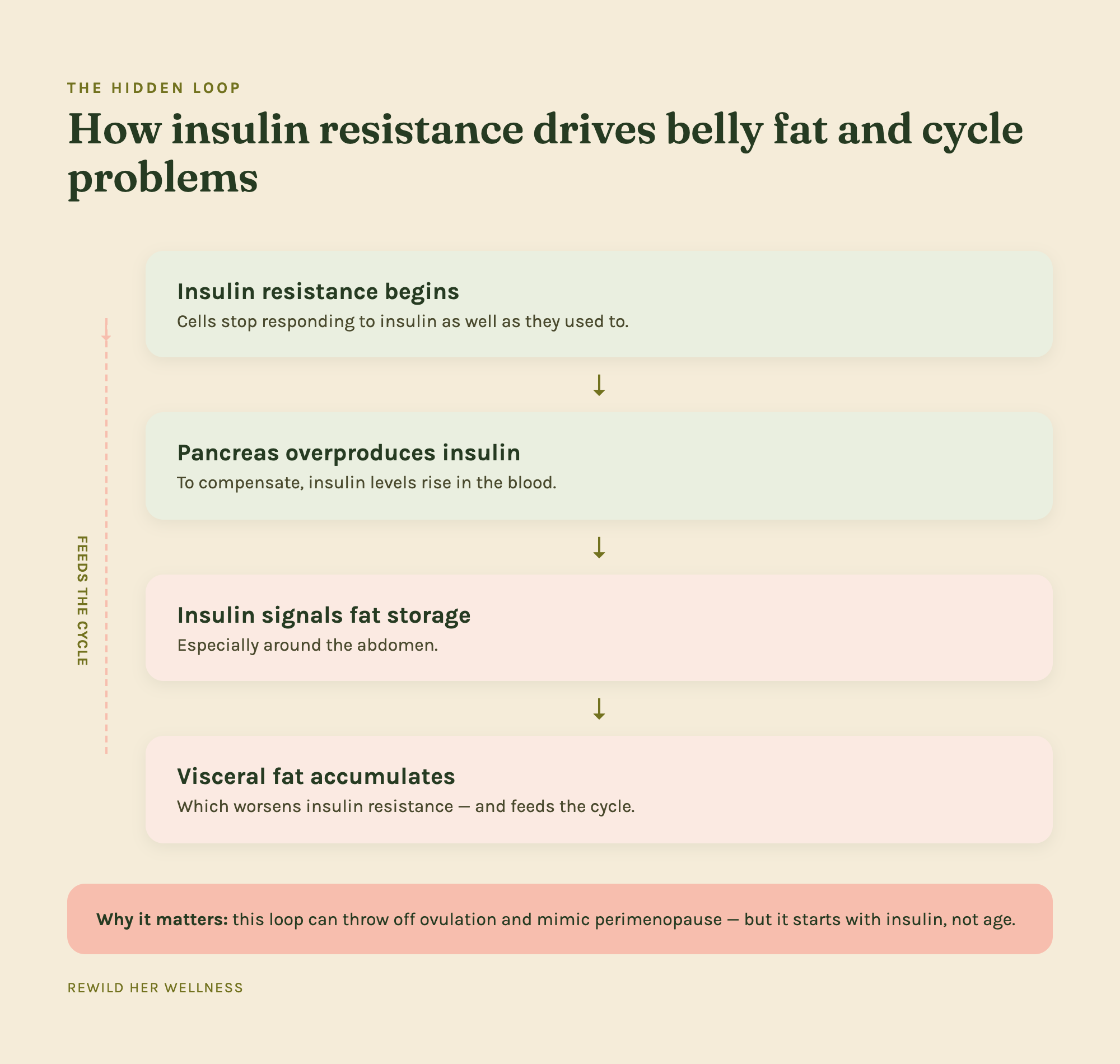
Standard “diet” advice underperforms in PCOS because of insulin resistance, a condition where your cells stop responding efficiently to insulin, forcing your pancreas to produce more of it. Roughly 50–70% of women with PCOS/PMOS have measurable insulin resistance, independent of body size.
Elevated insulin does two things that work directly against how your body wants to feel and function. It signals your body to store fat, particularly around the abdomen, and it makes it harder to access energy stores, even when you're eating thoughtfully.
This is also why two people can eat the exact same diet and get completely different results. If your insulin is chronically elevated, your body is biochemically primed to hold onto fat regardless of how "good" your food choices are. This is a physiology problem, not a discipline problem. Your pancreas isn't judging your salad choices. It's just doing its job a little too enthusiastically.
What’s Causing “PCOS Belly”?
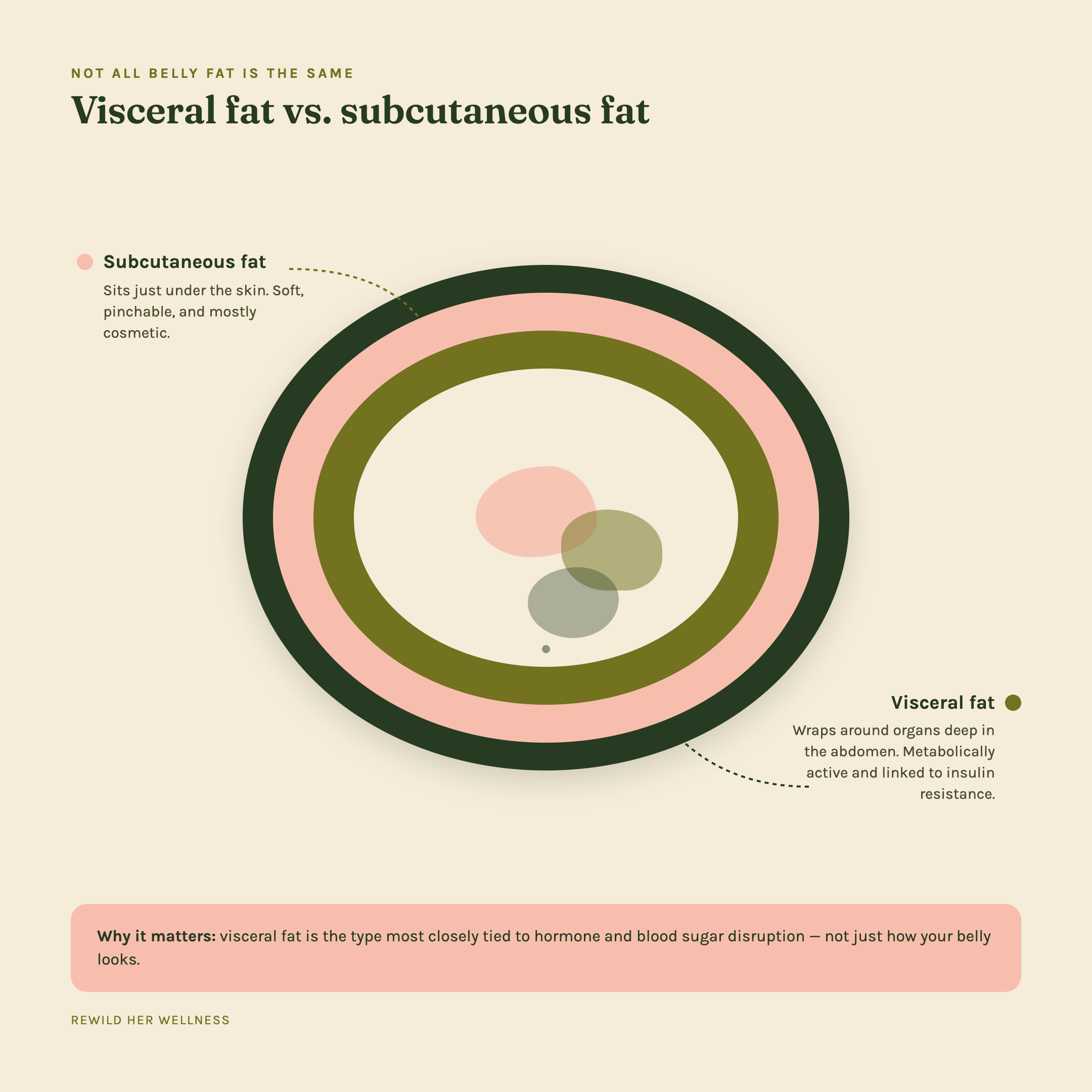
The "PCOS belly" refers to a pattern of central, visceral fat storage that's more common in PCOS/PMOS than in the general population, driven largely by insulin resistance and elevated androgens (male-typical hormones like testosterone). Unlike fat stored on the hips or thighs, visceral fat sits around your organs and is more metabolically active, which can further worsen insulin resistance in a frustrating feedback loop.
It's also worth naming that it's kind of shitty there's a term targeting women's bellies in the first place. That framing didn't come out of nowhere, it's the same diet culture and patriarchal beauty standard that's been telling women their stomachs are a problem to solve for decades. You are beautiful with any kind of belly, PCOS or not.
Anywho, this is why spot-reduction advice and generic ab workouts don't touch it. You can't out-crunch a hormonal fat-storage pattern; you have to address the insulin and androgen signaling underneath it. That's a very different starting point than "just work out more," and it's exactly where a personalized approach makes the difference.
What Helps: A Different Kind of Plan to Feel Good In Your Body
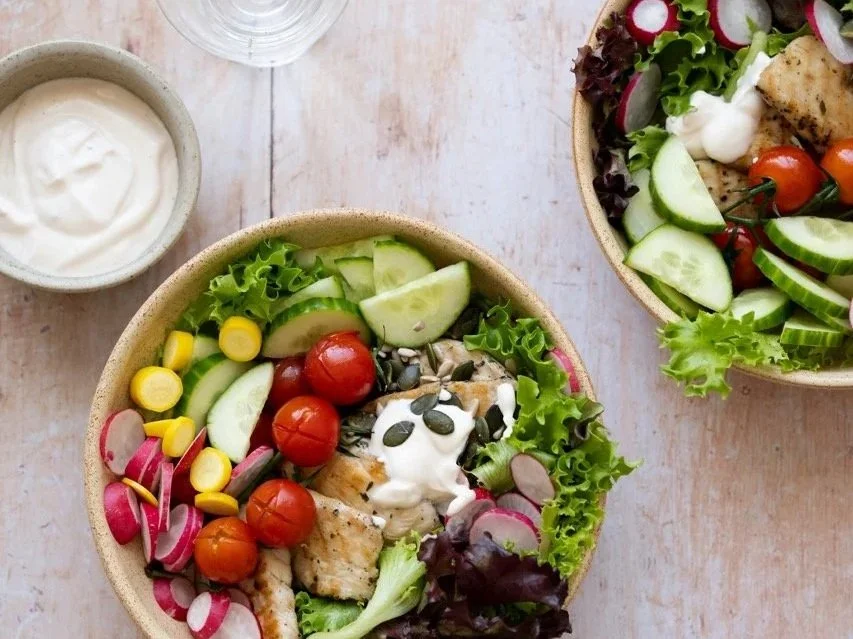
A workable plan for PCOS/PMOS starts with blood sugar regulation, not restriction. Pairing carbohydrates with protein, fat, and fiber blunts the insulin spike that a carb eaten alone would cause, which directly addresses the root mechanism instead of just cutting intake.
Strength training tends to outperform cardio-only routines for PCOS/PMOS, because muscle tissue improves how efficiently your body uses glucose, which lowers circulating insulin over time. Sleep and stress matter just as much: cortisol and insulin are hormonally linked, so a dysregulated nervous system can undercut even a well-designed diet.
This is the core of how I work with clients: blood sugar balance, nervous system regulation, and non-restrictive nourishment for happy hormones, tracked with gentle hormone data instead of guesswork. It's not a rigid diet with a start and end date. It's a way of eating and living that keeps working long after we stop meeting, which is truly the whole point.
Medication and Treatment: What Are Your Options?
Metformin remains the first-line medication for PCOS/PMOS-related insulin resistance, and it's been used off-label for this purpose for decades. It improves insulin sensitivity, and for some people that also shows up as changes in energy, cycle regularity, or body composition over time, though results vary widely between individuals.
Myo-inositol and D-chiro-inositol are supplements with a growing evidence base for improving insulin sensitivity and ovulation in PCOS/PMOS, often used alongside or instead of metformin depending on your provider's approach. Personally and anecdotally, clients have so much success in regulating their blood sugar with inositol.
None of this is a verdict on what you should choose. Treatment is not one-size-fits-all, and I collaborate with clients' doctors, endocrinologists, and OBs rather than replacing that care. What matters is that the decision is fully informed, not driven by panic or shame about your body.
You Can Be Well In Any Body, Even in an Ozempic-Saturated World
Here's what I want you to walk away with: your worth and your health aren't something a single outcome can measure, no matter how loudly the current cultural moment insists otherwise. Symptom improvement, like steadier energy, more regular cycles, or calmer blood sugar, can be a genuinely wonderful and achievable goal for people with PCOS/PMOS, particularly when it comes to restoring ovulation or lowering cardiovascular risk. That's simply not the only valid outcome, and none of it is ever a referendum on your beauty or your discipline.
Bodies come in different sizes at every level of metabolic health, and pushing yourself past what feels safe and sustainable just to hit an outcome someone else defined isn't a win, even if Instagram tells you otherwise this week. My work is about helping you understand what your specific body needs, with real data instead of guessing, so you can make choices that fit your life. Here’s more on why BMI alone doesn't tell the whole story.
If you've tried every protocol on Pinterest and still feel stuck, that's not a personal failing either! Common hormone advice often falls flat.
FAQs: PCOS, PMOS, and Weight Loss
Q: What should I do if I have PCOS and can't lose weight? A: Start by getting fasting insulin, HOMA-IR, and a full thyroid panel checked, since undiagnosed insulin resistance or thyroid dysfunction often explains why nothing seems to be working. From there, shift focus from restriction to blood sugar regulation, strength training, sleep, and stress support.
Q: How can I lose xx pounds with PCOS? A: There's no universal timeline or target that applies to every body, and I'd be doing you a disservice promising one. A sustainable approach addresses insulin resistance directly through nourishment, movement, and nervous system regulation, with medication considered case by case with your doctor.
Q: How do I know if my PCOS (PMOS) is getting worse? A: Watch for increasingly irregular or absent periods, new or worsening acne and hair growth, new fullness through your midsection, or new fatigue and mood changes. These often signal rising insulin resistance or androgen levels and are worth bringing to your provider.
Q: Does PCOS qualify for Ozempic? A: Ozempic isn't FDA-approved specifically for PCOS/PMOS, so any use is off-label and decided with your prescriber. Some patients qualify for the higher-dose versions, Wegovy or Zepbound, through the FDA-approved weight-management indication if their BMI and health history meet the criteria. I dive deeper into the research on GLP-1’s and PMOS in this post if you’d like to explore that connection further.
A Gentler, More Personalized Path Forward
You don't need another rigid diet or reason to feel like your body is working against you. What you need is a plan built around your real hormone data, your blood sugar, and your nervous system, not a generic protocol pulled off the internet.
If you're ready for a personalized, science-backed approach to PCOS/PMOS that doesn't ask you to shrink yourself to be worthy of care, I'd love to talk it through with you. Come as you are, questions included!
This post is educational and not a substitute for personalized medical advice. Always talk with a knowledgeable prescriber about your individual health history before starting or stopping any hormone therapy.
Last Updated: August 2026
Curious what’s driving your symptoms? Take the free 2-minute Untangle Your Hormones quiz to find your personalized pattern, and a clear next step to start feeling like yourself again!
If you liked this post, you may also like:
→ 11 Signs of Hormonal Imbalance in Women
→ Why Eating More Might Be the Key to Getting Your Period Back

About the Author
Hi, I’m Sam.
I help women whose hormones have been disrupted by stress or birth control reclaim rhythm and trust in their bodies. With lived experience, deep training, and a non-restrictive, nervous-system-friendly approach, I guide you to restore hormonal balance without control or restriction.



Perimenopause weight gain isn't a willpower problem. Here's why fasting can backfire and what really helps you feel strong, steady, and at home in your body.