
Last updated: September 2026
This post contains affiliate links and I may earn a small commission at no extra cost to you. I only recommend tools and products I personally use and trust.
Maybe this question isn’t “How do I stop my body from getting bigger?”
Instead, maybe it’s “ What is my body trying to tell me? And why have we been taught that any change in our body is a problem to solve?”
My genuine hope is to ground you in this radical idea to consider and take some pressure off of a perfectly natural and biological experience. We’re still going to get into the science :).
Why Am I Gaining Weight During Perimenopause?
You haven't changed anything. Same food, same workouts, same routine you've run for years, and suddenly the number on the scale (or the fit of your jeans) has other plans. If you've typed "perimenopause weight gain" into Google at 11pm while eating cereal over the sink, welcome, you're in good company. Most of what comes up will tell you to eat less and move more.
I'm going to say something a little heretical, but hear me out: that advice is backwards, and it's probably making things harder, not easier.
The short version: perimenopause weight gain is driven by hormonal shifts that change where fat is stored and how much muscle you naturally hold onto. It is not a sudden, mysterious loss of discipline you developed overnight. Restricting calories or fasting during this transition tends to worsen the exact problem it's trying to fix, according to new research out of the University of South Florida's Performance & Physique Enhancement Lab on caloric and protein intake across the menopause transition.
Here's what's really going on in your body, why the "just eat less" advice backfires, and what the research says works instead, plus my own answer to the cultural pressure that makes this so much harder than it needs to be. If you're also wondering whether you're even in perimenopause yet, start with the early signs before the scale even moves.
What’s Happening to Your Body In Perimenopause?
Perimenopause weight gain can be a thing, and it has a physiological cause. Declining and fluctuating estrogen shifts fat distribution toward the midsection and speeds up the loss of lean muscle mass. This is a body composition shift, not a "calories in, calories out" morality tale.
A 2025 survey of resistance trained women across the menopause transition, led by exercise scientist Dr. Bill Campbell's team found that protein intake often drops at exactly the point women need more of it to protect their muscle. A companion study from the same lab documented widespread "weight loss resistance," meaning women in a genuine caloric deficit who still weren't losing weight, among perimenopausal and postmenopausal women who exercise regularly
Translation: your body isn't broken, and she definitely isn't lazy. She's responding to hormonal change in a very predictable way that most diet advice conveniently ignores.
Why Dieting and Fasting Can Make Perimenopause Weight Gain Worse
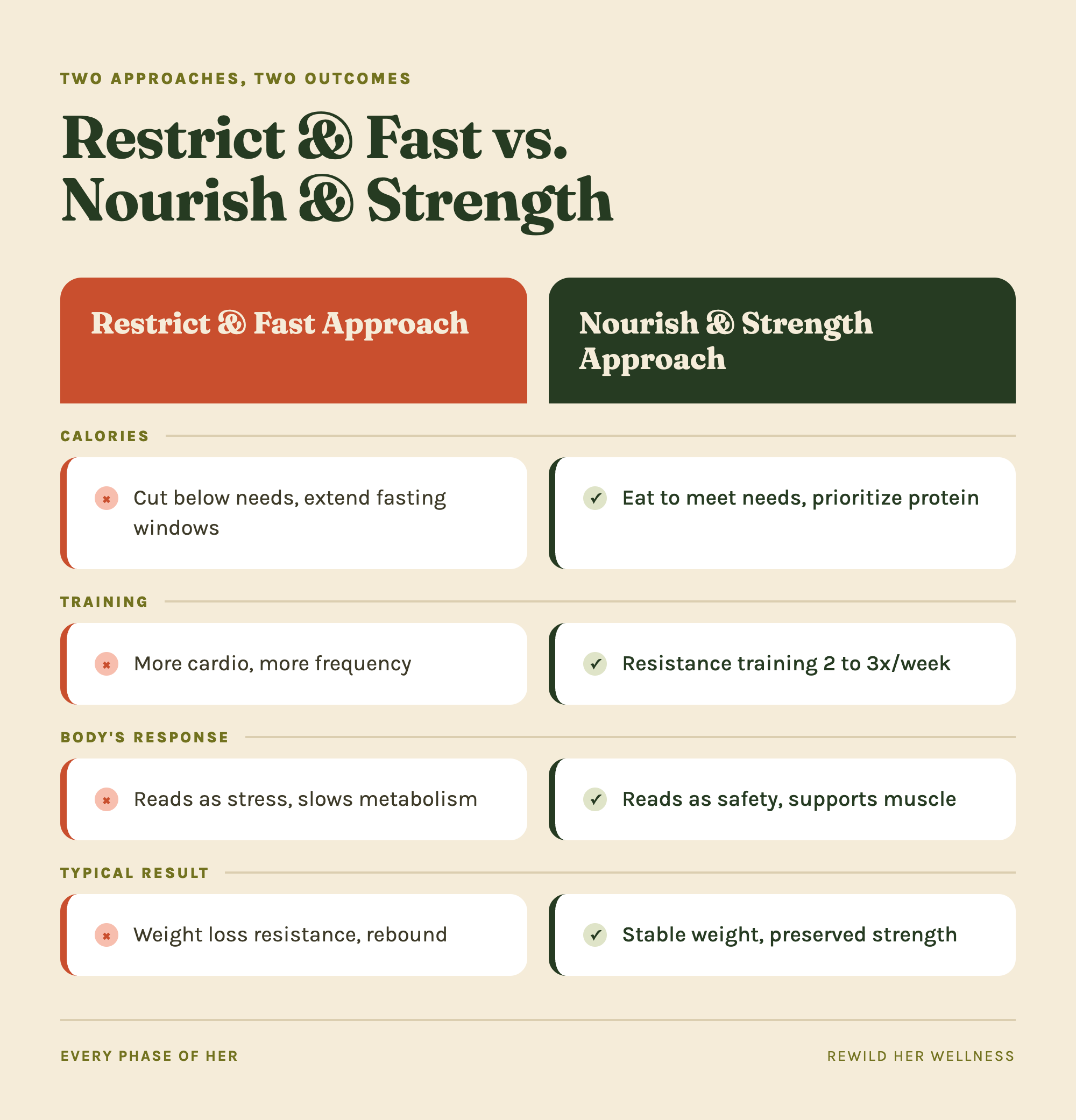
This is the part most perimenopause content gets wrong, loudly and often. When you restrict calories or stretch out your fasting window, your body doesn't file that under "getting healthier." It files it under "uh oh, famine," and starts acting accordingly.
This isn't a fringe idea. Set point theory, the concept that your body defends a genetically influenced weight range the same stubborn way it defends your body temperature, has research going back to the early 1980s and was brought to a mainstream audience by Dr. Lindo Bacon in Health at Every Size. Push your intake below that range, and your body responds by slowing your metabolism, cranking up hunger signals, and often, eventually, rebounding to a higher weight once the restriction ends. Your body isn't punishing you. She’s just really good at her job!
Layer perimenopause on top of that, and the stakes go up. A body already juggling hormonal volatility reads under-eating as one more stressor, which can worsen the cortisol and blood sugar swings driving that midsection weight gain in the first place. Fasting protocols that are trendy in general weight-loss culture are often the worst possible fit for this specific life stage.
Evelyn Tribole and Elyse Resch's Intuitive Eating makes a similar case from the clinical side: chronic restriction predicts more preoccupation with food and weight over time, not less. If "eating more" advice has ever struck you as suspiciously counterintuitive, this is the same principle behind restoring a missing period, just for a different hormonal season.
What Really Helps: Build Muscle, Don’t Shrink Yourself
If restriction is the wrong lever, what's the right one? 🤷🏻♀️ The current research keeps pointing to two things, done consistently: resistance training and enough protein. Not more cardio, and not less food.
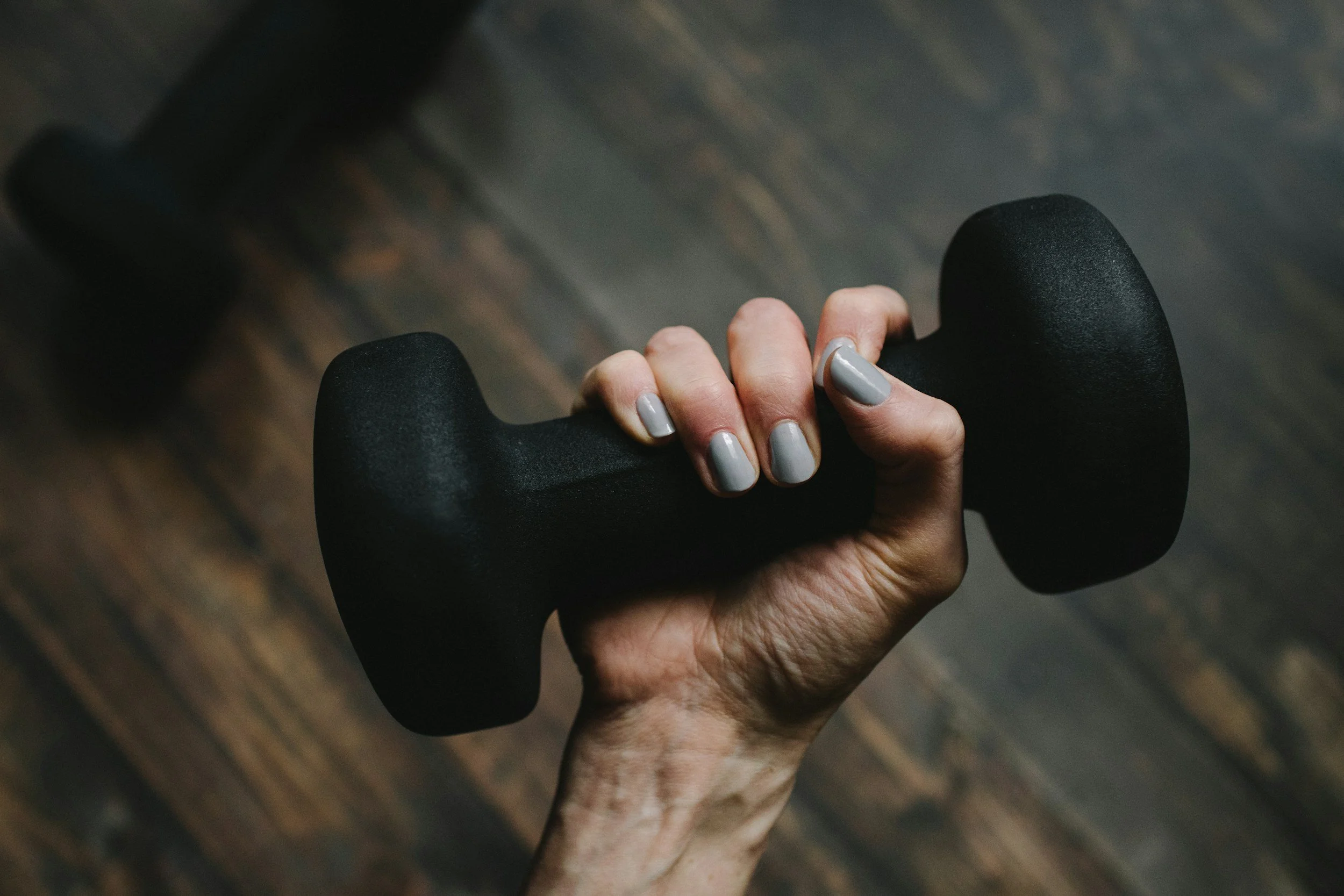
Muscle is metabolically protective tissue, and perimenopause is exactly when you start losing it fastest without some intervention. Strength training two to three times a week tells your body to hang onto, or rebuild, the lean mass that keeps your metabolism steady through this transition. Your future self, deadlifting, thanks you in advance.
Protein timing matters too. Getting 25 to 35 grams of protein at breakfast specifically, not just wedged in somewhere by dinner, helps stabilize blood sugar for the hours that follow and takes the edge off the 3pm crash-and-craving spiral so many women in perimenopause know well. Stable blood sugar is directly tied to how much cortisol your body releases, which is directly tied to where you store fat.
Awesome, Go-To Supplements for Perimenopause
Supplements won't replace food or resistance training, no matter how prettily the bottle is packaged, but two are worth knowing about for this stage specifically.
Magnesium supports insulin sensitivity and blood sugar regulation, which matters here because insulin resistance is part of why fat storage shifts to the midsection in perimenopause. It also supports GABA activity in the brain, which is why plenty of women notice a mood and sleep benefit right alongside the metabolic one. Here’s my favorite.
Taurine works on the calming neurotransmitter side too. It interacts with GABA and glycine receptors in ways researchers have linked to better sleep and fewer perimenopausal mood symptoms, and it's been studied for a supporting role in insulin sensitivity as well.
Neither one is a fix on its own. Think of them as backup dancers for the eating and training changes above, not the headliner.
This Isn’t About Willpower. It’s About Culture.
Here's the part I want to say plainly: the pressure to "fix" a changing midlife body isn't just biological, it's cultural, and it's loud. Lexicographer Erin McKean put it better than I ever could: "Prettiness is not a rent you pay for occupying a space marked 'female.'" It's a line Lara Briden references in Hormone Repair Manual, and it's been living rent free in my head (pun very much intended!) ever since I read it.
I relate to this more than I'd like to admit. Even doing this work for a living, even fully aware of how patriarchal the pressure to look a certain way through midlife really is, I still feel it creep in some days. What helps is remembering two things: you are not the only one carrying this, every woman in this transition is feeling some version of it whether she says so out loud or not, and there is another way through. You can be nourished, strong, and genuinely well in perimenopause and beyond, without shrinking yourself to earn it.
FAQs: Perimenopause Weight Gain
Q: How do I stop weight gain during perimenopause? A: Focus on resistance training two to three times a week and eating enough, especially protein at breakfast, rather than cutting calories. Restriction tends to worsen perimenopause weight gain by raising stress hormones and slowing your metabolism.
Q: What stage of perimenopause do you gain weight? A: Weight and fat redistribution often begin in early to mid perimenopause as estrogen starts fluctuating, and can continue through late perimenopause and into early postmenopause as hormone levels decline further.
Q: Is it normal to gain 20 pounds during perimenopause? A: Weight gain varies a lot by individual; some women gain little, others more. What's consistent across research is a shift toward midsection fat storage and muscle loss. The scale number matters less than body composition.
Q: What is the best supplement for perimenopause weight gain? A: Magnesium and taurine are worth considering for their roles in insulin sensitivity and mood, but no supplement replaces adequate protein intake and resistance training as the main levers during this transition.
You aren’t failing. Your body is adapting.
Perimenopause weight gain isn't a discipline problem, and it isn't proof your body has stopped working. It's a hormonal transition asking for a different approach than the one diet culture keeps handing you on repeat: more nourishment, more strength training, less restriction.
If you'd like to understand your own hormonal picture more clearly, the free hormone quiz is a good starting place!
👉Take the free hormone quiz to identify your primary hormonal pattern
And if you're ready for personalized, evidence-based support on your preconception journey, a discovery call is the first step.
👉Book your free discovery call with Sam
Last Updated: September 2026

About the Author
Hi, I’m Sam.
I help women whose hormones have been disrupted by stress or birth control reclaim rhythm and trust in their bodies. With lived experience, deep training, and a non-restrictive, nervous-system-friendly approach, I guide you to restore hormonal balance without control or restriction.


Perimenopause weight gain isn't a willpower problem. Here's why fasting can backfire and what really helps you feel strong, steady, and at home in your body.